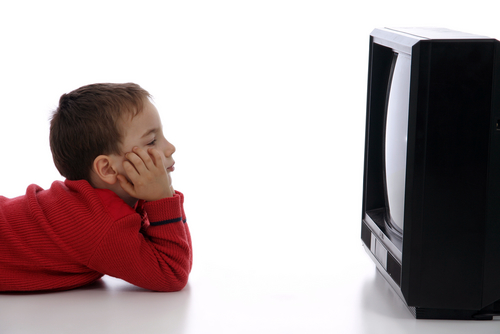
Whatever your problem...it's not the TV's fault.
Got a problem? Surely, there’s someone you can blame. Americans love to point their fingers at anything that will help explain, rationalize or otherwise dismiss any of their own faults and shortcomings. Unfortunately, most seem to forget that old playground proverb that says, “whenever you point a finger, there’s always three pointed right back at you”. Nonetheless, everyone still seems to have an excuse for everything. Too fat? It’s genetics. Your kids do poorly in school? It’s ADHD. Fed up with politics? It’s the Republicans. No matter what ails you or what predicament you face, there’s someone other than yourself to blame. And nothing shoulders more of that unwarranted blame than Television.
Pick a problem plaguing our world today and you’ll surely find someone saying that TV is at fault. Violence, laziness, ignorance, corruption and moral decay all have their bony fingers pointed directly at the glowing black box that sets innocently in every one of our homes. But just as with all of our other problems, affixing blame onto television is ensuring that the blame is misplaced. Viewers shoulder the blame. We shoulder it not only for our viewing decisions, but also because of the ways that we relate to the content of the programming choices we make. Television will give back exactly what we seek to get out of it. The way in which we engage with television will determine the results. So if your TV is making you dumber, you’ve only got yourself to blame.
I’m sure you’ve heard all this before. Many have already made the argument that if we would just pick up our remotes and change the channel from MTV to C-SPAN, the world would be a better place. If only we could just see fit to watch “Masterpiece Theater” rather than “Jersey Shore” our culture could arise from its cesspool of iniquity and once again thrive. This is not my argument. Television doesn’t need to be ‘high-minded’ to have a positive influence. What matters is how we respond. Even the simplest or tawdriest of programs can be meaningful depending on if and how we seek to derive meaning from them. My argument deals more with the way we process information and less with the substance of the information that is provided. TV programming of all varieties can prove to be enlightening if we as viewers make the choice to put our minds to work. As soon as we make the choice to allow TV to merely serve as a mindless daily sedative, then that is exactly what it will become.
For instance, ABC’s “The Bachelor” is one of the most inane shows ever conceived. It is a show that promotes narcissism, materialism and shallow relationships and stars a group of irrational, young bubbleheads who share the word “amazing” as the only adjective in their collective vocabulary. At first glance, this show possesses no redeeming qualities and quite possibly makes anyone who watches it not only stupider, but also a little more cynical and shallow as well. But is that really true? We all watch TV from a subjective vantage point, so depending on the viewer’s attitude and disposition, perhaps even this monstrosity could reap positive results. For those who watch analytically and make sure their brain remains working even while the TV is on, doesn’t “The Bachelor” have plenty to say about the flaws of modern relationships? Personally, when I watch, I’m often wondering to myself what makes it possible for a young woman to honestly believe she’s in love with a man who is simultaneously sharing intimate moments with other potential suitors. “The Bachelor” may not be an accurate reflection of relationships in 2011, but that doesn’t mean that when its layers are peeled away there isn’t still something valuable to learn about human nature. By resisting the temptation to get caught up by the choreographed drama and emotion that the show’s producers try to create, you’re left with the chance to ponder the motivations and desires of good-looking, seemingly successful young people and how they approach finding a mate. As shallow as “The Bachelor” is, it still allows you the chance to think deeper, if you’re so inclined.
When we put our brains to work, lose our passivity and become actively engaged in our programming, almost any show can escape its seemingly narrow confines and provide us with something worthwhile. Take MTV’s “Teen Mom” for instance. On its surface, and similarly to a whole host of other ‘reality’ shows, “Teen Mom” is nothing more than basic voyeurism. It is providing the viewer a simple opportunity to gawk in amazement at the sorry state of those who are less fortunate than themselves. But this is a show that, if viewed with a curious rather than judgmental mind, can provide an immense amount of information and insight into a phenomenon that affects countless people across the country. “Teen Mom” is not just about the poor parenting techniques of 16 year-olds, it’s about incredibly important issues such as abortion, adoption, domestic violence, the value of education and the role that healthy families play in sustaining a productive society. If it is viewed merely as a shocking spectacle, it loses its potential to teach. But if we go beyond just ‘watching’ and seek to understand how it reflects the world around us, following a show like this can be an enlightening experience.
The same is true for a whole host of shows. We watch “Hoarders” and “Biggest Loser” and “American Idol”. It can be entertaining and emotionally engaging, but at the same time, can’t it also be educational? We’re fascinated by their situations, their addictions and their ambitions, but can’t we also be stimulated by the lessons they provide about materialism, consumption and our quest for fame? “The Biggest Loser” should not be seen as a show about weigh-ins and silly competitions. It’s a show about our culture’s relationship to food, our declining active lifestyles and our search for fulfillment in all the wrong places. But in order for those lessons to sink in, we have to actively seek them out. It’s analogous to going to the zoo or a museum. We can walk through and be fascinated by the animals and the displays and be on our way, or we can stop and examine the details, read the presentations and absorb their broader purpose. If we want television to be more than just an attraction, then the responsibility is ours to make that happen.
However, that responsibility also includes a caveat. Active thinking is not the only requirement necessary to make watching television educational or meaningful. Unfortunately, it also matters “what” we’re thinking about. If you watch a national cable news broadcast and through its false presentations it compels you to ponder whether or not our President was actually born in America, then you’re probably not accomplishing anything positive. If you watch endless hours of sports commentary and it leads you to waste your mind contemplating which team should win Friday’s big game, then you’re also on a fool’s errand. Following the nightly parade of police blotter details on your local news may get your mind whirling, but chances are all that thinking won’t bring about many worthwhile results. It’s great for a viewer to be captivated by a show, but if all the show is doing is causing them to reflect on a certain celebrity’s dancing ability, then perhaps it’s not the most effective use of their mind. We should all be able to recognize for ourselves if the programs we’re watching have the capability to provoke constructive thought. In all of the previously mentioned examples, constructive thought is indeed a possibility. Making our television watching meaningful requires the viewer to not only make wise choices, but to also then be conscious of the reaction those choices will most likely to draw out.
If what I’ve just described seems to require too much effort, don’t worry. There is an unprecedented amount of television programming out there that by its very nature is enlightening and doesn’t require any mental discipline to achieve its beneficial results. Grab your remote and everywhere you turn you’ll find a show about remodeling your kitchen, the lifestyles of ancient Mayan civilizations or how to cook delicious bbq brisket. You can learn about swordfishing and wilderness survival in the afternoon and catch up on genetic science and American history later that evening. Anyone who wants to bemoan the value and educational capabilities of television is certainly not paying close enough attention. Stimulating, thought-provoking television is available for even the most discerning of tastes. And the networks that broadcast these shows are not just relegated to the periphery. Channels like HGTV, Discovery and The Food Network are some of the most-watched cable channels on the air. Whatever topic interests you, whatever subject stimulates your brain, you’re sure to find a presentation of it somewhere on your television dial. If a viewer was so-inclined, they could focus their viewing exclusively on educational programming and still never run out of options.
But how many of us are quite that dedicated about their TV viewing habits? Even though we may aspire to make television-watching a worthwhile endeavor, the intelligent, high-minded programming often loses out. We watch TV because we want to laugh, because we want to be entertained and because we want to root for our favorite teams. Television serves as an escape, so naturally people are going to be quick to choose shows like “The Office” instead of a new episode of “Frontline”. There is nothing wrong with this phenomenon. But as with almost every option we encounter in our consumer culture, moderation is the key to achieve positive results. It’s okay if you like to eat donuts, just try not to have one for breakfast every single day. The same is true for television. You may like to watch “Family Guy”, but you probably shouldn’t make that your choice every night. As I’ve already explained, something of value can still be taken away, regardless of which show you choose. Perhaps you missed out on a captivating recount of the 2008 financial crash when you chose “The Office” instead of “Frontline”, but who’s to say that some biting satire of corporate culture, mixed in with a few laughs, can’t be just as enlightening?
Those looking to place the blame on television for whatever social ill they have in mind will probably not be swayed by my arguments. Many just reflexively view TV as a sub-standard format that will always be playing catch-up with the “more intellectual” entertainment options like cinema, live-theater and books. I can still remember the desperate pleas of my English Teachers imploring us, for the sake of our own cognitive futures, to turn off the TV and pick up a book. I will always be someone that defends the value of literature , but I never understood why TV received such a bad rap. Reading can be a wonderfully enriching enterprise, but there are aspects of our lives and our culture that can be much more accurately reflected and conveyed through a television screen. And let’s not pretend that the breadth of idiotic TV programming isn’t matched by an equally wide breadth of idiotic books. I recently went on vacation and paid particular attention to the reading choices the people around me had made for their flight and for their time on the beach. Everywhere I looked, my fellow vacationers had their noses buried deep in celebrity biographies, factually-challenged political screeds, dime-a-dozen mysteries and dull religious hot air. I saw no one reading the classics, no how-to books, no research-driven non-fiction and and nothing that rose above what’s innocently known as “light reading”. Books are great, but there’s no way that reading Sarah Palin’s latest offering is anymore enlightening than watching an episode of “Grey’s Anatomy”. They’re both fluff and both should only take an hour to get through.
The biggest problem with everything I’ve just laid out is that ultimately, the quality and depth of each individual’s television-watching experience is completely up to them. It’s this unfortunate circumstance that gives the ‘blame TV’ crowd its most compelling argument. TV can actually be dumb. It can be violent, it can be lazy and can be apt to reflect a shallow understanding of our world. But that’s not TV’s fault. On the whole, TV responds to what the market demands. If vast majorities of our society wanted smarter programming, then it would most likely be so. But our society instead demands hours of cop shows about dead hookers, over-dramatized ‘reality’ programs, dishonest newscasts and exploitative spectacles of those who are downtrodden or different. TV gives that to us because apparently that’s what we want. But TV did not create those desires. Our flawed inclination to watch awful TV is caused by a whole host of factors strung throughout every fabric of our culture. Blaming television is merely making it a scapegoat for broader problems. Television is not so much the cause as it is a reflection. The opportunity exists for all of us to allow television, even in its current state, to have a positive affect on our lives. So sit down, tune-in and bask in its enchanting warm glow. TV is your friend and it doesn’t deserve your scorn, because if watching TV is making you dumber…you’ve only yourself to blame.


 Posted by Jason Batts

 Battsland